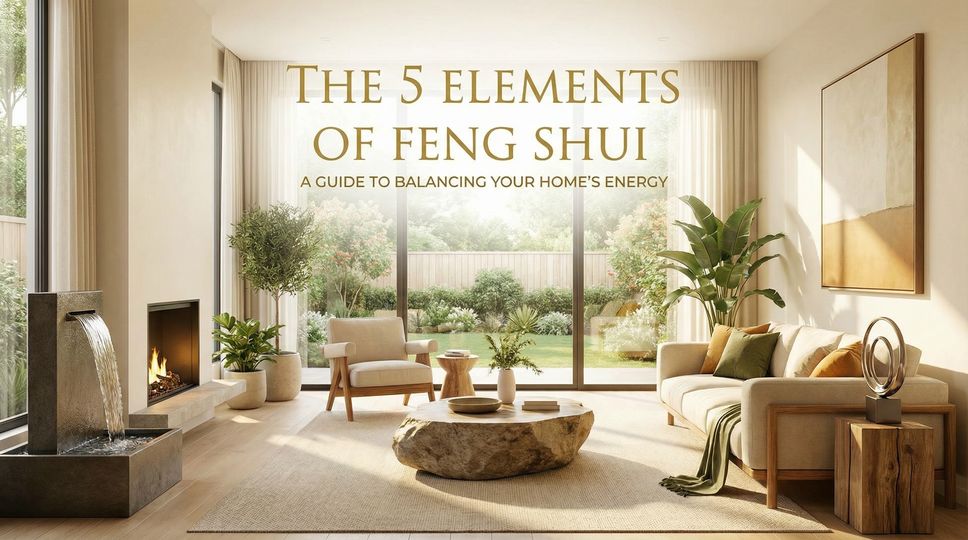
While moving furniture and decluttering are the most visible aspects of Feng Shui, the true magic lies deeper in the philosophy. Once you understand the flow of Chi (energy), the next step in your Feng Shui journey is mastering the Five Elements (Wu Xing).
If you have ever walked into a room and felt that it was "too cold," "too sterile," or conversely, "too chaotic," you were likely sensing an elemental imbalance.
The Five Elements—Wood, Fire, Earth, Metal, and Water—are the building blocks of Feng Shui practice. They represent different phases of energy, and by incorporating them thoughtfully into your decor, you can curate specific feelings and outcomes in your life, such as relaxation, focus, or passion.
In this guide, we will explore what each element represents and how to use colors, shapes, and materials to bring harmony to your living space.
The Cycles of Nature
Before we dive into the specific elements, it is crucial to understand how they interact. In Feng Shui, elements do not exist in isolation; they interact in cycles.
1. The Productive Cycle (Creation)
This cycle mimics the way nature creates life. Using this cycle helps you boost the energy of a specific sector in your home.
- Wood feeds Fire.
- Fire creates Earth (ash).
- Earth bears Metal.
- Metal holds Water (condensation).
- Water nourishes Wood.
2. The Destructive Cycle (Control)
This cycle is used when an element is too strong and needs to be weakened or controlled.
- Wood parts Earth.
- Earth absorbs (dams) Water.
- Water extinguishes Fire.
- Fire melts Metal.
- Metal chops Wood.
Understanding these relationships prevents design disasters, such as placing too much Water energy (blue colors, fountains) in a Fire zone (like the kitchen stove area), which can dampen vitality.
Deep Dive: The Five Elements
Here is how to identify and utilize each element in your interior design.
1. Wood (Growth and Vitality)
Wood energy is the energy of spring, new beginnings, and expansion. It represents health and family vitality. If you feel stagnant or stuck in a rut, introducing Wood energy can help jumpstart personal growth.
- Key Attributes: Expansion, flexibility, kindness.
- Colors: Green, teal, and light blue.
- Shapes: Tall, vertical, columnar shapes (like tree trunks).
- Decor Items:
- Live plants (the best source).
- Images of forests or landscapes.
- Cotton and natural fabrics.
- Vertical striped wallpaper or curtains.
2. Fire (Passion and Visibility)
Fire is the element of high energy, passion, and fame. It is the most "active" (yang) of all elements. You need Fire energy if you feel lonely, uninspired, or if you want to gain more recognition in your career.
- Key Attributes: Passion, transformation, attention.
- Colors: Red, orange, bright yellow, pink, purple.
- Shapes: Triangles, pyramids, jagged edges.
- Decor Items:
- Candles and fireplaces.
- Lighting fixtures (lamps, bright bulbs).
- Animal prints or leather.
- Art depicting sunshine or fire.
3. Earth (Stability and Grounding)
Earth energy is the pausing point between seasons. It represents stability, nourishment, and protection. If your life feels chaotic or you are suffering from anxiety, Earth elements bring a sense of centering and calm.
- Key Attributes: Stability, trust, nourishment.
- Colors: Beige, sandy, taupe, terracotta, soft yellow.
- Shapes: Squares, rectangles, low and flat surfaces.
- Decor Items:
- Ceramics, pottery, and clay objects.
- Heavy furniture that sits low to the ground.
- Landscape art depicting flat horizons (deserts, fields).
- Thick wool carpets.
4. Metal (Clarity and Precision)
Metal is the energy of autumn and harvest. It is associated with focus, clarity, and efficiency. If you are procrastinating, lacking direction, or feeling "foggy," Metal energy helps sharpen your mind.
- Key Attributes: Logic, precision, efficiency.
- Colors: White, gray, silver, gold, metallic finishes.
- Shapes: Circles, arches, ovals.
- Decor Items:
- Metal frames, vases, or sculptures.
- Round tables or mirrors.
- White pillows or rugs.
- Minimalist decor.
5. Water (Wisdom and Flow)
Water is the energy of winter and stillness. It is linked to wisdom, intuition, and career flow. It also governs wealth (as water flows like money). If you feel stressed, burned out, or rigid, Water energy can help you relax and go with the flow.
- Key Attributes: Wisdom, connection, fluidity.
- Colors: Black, charcoal, dark blue.
- Shapes: Wavy, curvy, amorphous shapes.
- Decor Items:
- Fountains or aquariums.
- Mirrors (which reflect light like water).
- Glass surfaces.
- Art depicting oceans, rivers, or waterfalls.
How to Balance Your Home
A common mistake beginners make is assuming they need equal amounts of every element in every room. This is not the case. The goal is balance relative to the room's purpose.
The Bedroom
The bedroom should be a place of rest. Therefore, you want to emphasize Earth (stability) and perhaps soft Wood (health). Avoid too much Water (can cause emotional drift) or too much Fire (can cause restless sleep).
The Home Office
A workspace benefits from Metal (focus and clarity) and Water (wisdom and career flow). If the space feels too sterile, add a small plant (Wood) to encourage business growth.
The Living Room
This is a social space. Earth creates a grounded environment for conversation, while touches of Fire encourage laughter and connection.
Quick Tips for Diagnosis
Look around your space right now. Do you see an overwhelming amount of one color or shape?
- Too much White/Metal? The space might feel clinical and cold. Remedy: Add Fire (red accents) to melt the rigidity, or Water (black/blue) to soften the edges.
- Too much Wood/Plants? The space might feel overwhelming or jungle-like. Remedy: Add Metal (white/gold) to "chop" the wood and bring order.
- Too much Earth/Beige? The space might feel heavy, boring, or sluggish. Remedy: Add Wood (plants/greens) to break up the soil.
Conclusion
Feng Shui is an art of observation. By learning to see your home through the lens of the Five Elements, you move beyond simple decoration and start designing for how you want to feel.
Start small. Pick one room that feels "off," identify the dominant element, and introduce an element from the Productive or Destructive cycle to bring it back into harmony. As you adjust the elements in your home, you may find that the elements of your life start to balance out as well.