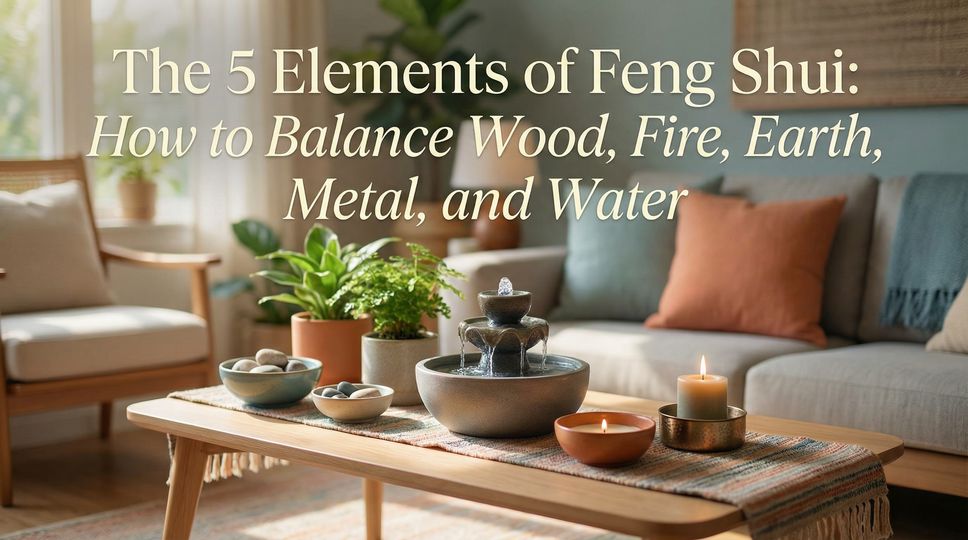
In our previous posts, we explored the foundations of Chi (energy) flow and the importance of the Bagua map. Now, we delve into the system that acts as the 'diagnostic tool' of Feng Shui: The Five Elements Theory.
If you have ever walked into a room and felt that it was too sterile, too chaotic, or simply uninviting, the culprit is often an elemental imbalance. Understanding how Wood, Fire, Earth, Metal, and Water interact is the secret sauce to taking your interior design from merely aesthetic to energetically potent.
In this guide, we will break down each element, identify its characteristics, and provide practical tips on how to introduce them into your space to cultivate harmony.
Understanding the Cycles of Energy
Before we look at the specific elements, it is crucial to understand that in Feng Shui, these elements are not static objects; they are phases of energy. They interact in two primary cycles:
- The Productive Cycle (Creation): Wood feeds Fire; Fire creates Earth (ash); Earth creates Metal; Metal holds Water; Water feeds Wood. This cycle represents support and growth.
- The Destructive Cycle (Control): Wood parts Earth; Earth absorbs Water; Water extinguishes Fire; Fire melts Metal; Metal chops Wood. This cycle represents control and reduction.
When a room feels 'stuck,' we use the Productive cycle to boost energy. When a room feels overwhelming, we use the Destructive cycle to tame it.
1. Wood (Mu)
Represents: Growth, vitality, new beginnings, and expansion. It is the energy of spring.
When your home has healthy Wood energy, you feel motivated, creative, and expansive. However, too much Wood can lead to feeling overwhelmed or stubborn, while too little can cause stagnation and a lack of creativity.
How to Bring Wood into Your Home:
- Live Plants: The most potent source of Wood energy. Think tall, upward-growing plants like bamboo or fiddle leaf figs.
- Colors: All shades of Green and Teal.
- Shapes: Rectangular, columnar, and vertical shapes.
- Materials: Cotton, natural fabrics, and obviously, wood furniture.
Feng Shui Tip: Place a healthy green plant in the 'Family' (East) or 'Wealth' (Southeast) corner of your home to stimulate growth in relationships and finances.
2. Fire (Huo)
Represents: Passion, visibility, transformation, and high energy. It is the energy of summer at noon.
Fire is the most volatile element. A balanced Fire element brings warmth, enthusiasm, and sexual energy. Excessive Fire leads to anger, aggression, and burnout. A lack of Fire results in emotional coldness and low self-esteem.
How to Bring Fire into Your Home:
- Lighting: Candles, fireplaces, and bright, warm lighting.
- Colors: Red, strong Orange, bright Yellow, Pink, and Purple.
- Shapes: Triangles, pyramids, and star shapes.
- Art: Images of sunrises, sunsets, or abstract art with dynamic movement.
Feng Shui Tip: Introduce Fire elements in your living room or office to boost recognition and social connection. Be careful using strong Fire energy in the bedroom, as it can disrupt sleep.
3. Earth (Tu)
Represents: Stability, grounding, nourishment, and trust. It is the energy of the harvest.
Earth is the pausing point between seasons. When balanced, your home feels cozy, safe, and structured. Too much Earth creates a heavy, sluggish atmosphere (boredom), while too little leads to anxiety and chaos.
How to Bring Earth into Your Home:
- Decor: Ceramics, clay pots, stones, and crystals.
- Colors: Beige, sand, taupe, terra cotta, and light yellow.
- Shapes: Squares and low, flat rectangles.
- Textiles: Heavy, textured rugs and thick blankets.
Feng Shui Tip: The bedroom is a perfect place for Earth elements. Use a square rug or beige linens to create a grounding, restful environment that supports stability in relationships.
4. Metal (Jin)
Represents: Clarity, logic, precision, and efficiency. It is the energy of autumn.
Metal helps cut through distractions. A home with balanced Metal energy fosters focus and organization. However, an excess of Metal can make a space feel sterile, cold, and uninviting (like a hospital). A deficiency leads to a lack of focus and inability to complete tasks.
How to Bring Metal into Your Home:
- Decor: Metal fixtures (gold, silver, copper, brass), hardware, and electronics.
- Colors: White, Gray, and Metallics.
- Shapes: Circles, arches, and spheres.
- Stones: White stones and marble.
Feng Shui Tip: If your home office feels cluttered and you cannot concentrate, add a metal lamp or a round white rug. This introduces the 'cutting' energy needed to sharpen your mind.
5. Water (Shui)
Represents: Wisdom, flow, career, and connection to spirituality. It is the energy of winter.
Water is unique because it can be still or flowing. Balanced Water energy allows for emotional release, insight, and adaptability. Too much Water can lead to feeling emotionally drowning or adrift. Too little Water results in stress, loneliness, and rigidity.
How to Bring Water into Your Home:
- Features: Aquariums, fountains, or a bowl of clean water.
- Colors: Black, charcoal, and deep dark Blue.
- Shapes: Wavy, free-form, and amorphous shapes.
- Surfaces: Mirrors and reflective glass surfaces.
Feng Shui Tip: Place a small fountain near the entrance of your home (flowing inward) to invite wealth and opportunities to flow into your life.
Harmonizing Your Space: A Practical Exercise
You do not need to redesign your entire house to use the five elements. Start small by diagnosing a single room that feels 'off.'
Ask yourself:
- Is the room too cold? (Too much Metal/Water). Solution: Add Fire (red pillows) or Wood (plants).
- Is the room too chaotic? (Too much Fire). Solution: Add Earth (square ceramics) or Water (a mirror) to cool it down.
- Does the room feel stagnant? (Too much Earth). Solution: Add Wood (plants) or Metal (white accents) to get energy moving.
Remember, good Feng Shui is not about having equal amounts of every element in every room. It is about creating a balance that supports the function of that specific space. A kitchen naturally has Fire and Water; a bathroom naturally has Water. Your goal is to ensure no single element overpowers the others to the point of discomfort.
By mastering the interplay of the five elements, you become the conductor of your home's energy orchestra, creating a symphony of balance, health, and prosperity.