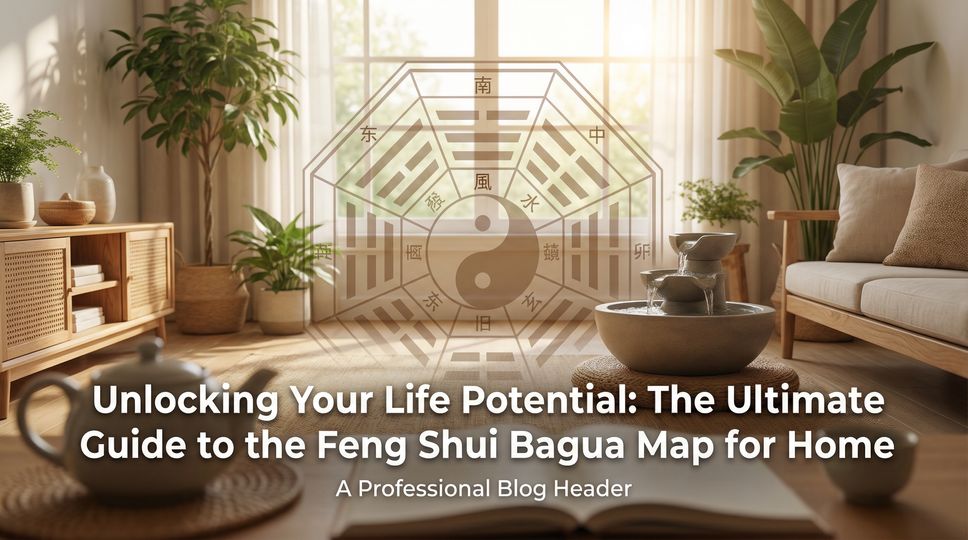
Unlocking Your Life Potential: The Ultimate Guide to the Feng Shui Bagua Map for Home
Have you ever felt that certain aspects of your life—be it your career, your relationships, or your finances—are stagnant, despite your best efforts to improve them? In Feng Shui, we believe that your home is not just a shelter; it is a three-dimensional vision board that mirrors your internal life. The key to decoding this mirror is the Bagua map for home layouts.
As the first post in our comprehensive Feng Shui series, we are going back to basics. To truly harmonize your living space, you must first understand the energy blueprint that lies beneath it.
In this guide, we will explore what the Bagua is, the two primary methods of applying it, and a step-by-step tutorial on how to overlay this energy map on your own floor plan to manifest your intentions.
What is the Bagua Map?
"Bagua" (bounds as bah-gwah) translates literally to "eight areas" in Chinese. It is an octagonal (or sometimes square) energy map used in Feng Shui to analyze the energy field of your environment.
The map divides your space into nine separate zones (eight directions plus the center). Each zone corresponds to a specific area of your life, as well as specific elements, colors, and shapes. When the energy (Qi) flows freely through these areas, your life flows smoothly. When these areas are cluttered or blocked, you may experience resistance in the corresponding life sector.
The Two Schools of Thought: Compass vs. Western
Before you grab your floor plan, you need to choose a method. There is often confusion because there are two ways to orient the Bagua map for home usage:
- Classical (Compass) School: This method relies on the actual cardinal directions (North, South, East, West). You use a compass to determine the facing direction of your home and overlay the map accordingly.
- Western (BTB) School: This method is often more accessible for beginners and is based on the flow of energy from the main entrance. In this school, the "North" of the map always aligns with the wall containing your front door.
For the purpose of this guide, we will focus on the Western/BTB method, as it is highly effective for modern architecture and emphasizes the psychological connection to the entry point of the home.
The 9 Life Areas of the Bagua
Imagine a tic-tac-toe board placed over your home. Here is a breakdown of the nine squares and what they represent:
1. Wealth & Prosperity (Xun)
- Location: Back Left corner
- Element: Soft Wood
- Colors: Purple, Gold, Green
- Represents: Abundance, financial flow, and self-worth.
- Enhancement Tip: Place a healthy money tree or a bowl of coins here.
2. Fame & Reputation (Li)
- Location: Back Center
- Element: Fire
- Colors: Red, Orange
- Represents: Visibility, recognition, and how the world sees you.
- Enhancement Tip: Good lighting, candles, or awards and diplomas.
3. Love & Relationships (Kun)
- Location: Back Right corner
- Element: Earth
- Colors: Pink, Red, White
- Represents: Romantic partnerships, self-love, and motherly energy.
- Enhancement Tip: Use pairs of items (two pillows, two candles) or rose quartz crystals.
4. Family & New Beginnings (Zhen)
- Location: Middle Left
- Element: Hard Wood
- Colors: Green, Teal
- Represents: Ancestry, family harmony, and starting new projects.
- Enhancement Tip: Family photos or tall, vertical plants.
5. Health & Well-being (Tai Qi)
- Location: Center
- Element: Earth
- Colors: Yellow, Earth Tones, Brown
- Represents: Physical health, balance, and grounding.
- Enhancement Tip: Keep this area open and uncluttered; a square rug works well here.
6. Children & Creativity (Dui)
- Location: Middle Right
- Element: Metal
- Colors: White, Metallics
- Represents: Joy, children, creative projects, and completing tasks.
- Enhancement Tip: Art supplies, metal décor, or round shapes.
7. Knowledge & Self-Cultivation (Gen)
- Location: Front Left corner
- Element: Earth
- Colors: Dark Blue, Black, Dark Brown
- Represents: Skills, wisdom, and spiritual growth.
- Enhancement Tip: Books, meditation cushions, or a quiet reading nook.
8. Career & Life Path (Kan)
- Location: Front Center
- Element: Water
- Colors: Black, Very Dark Blue
- Represents: Your job, your purpose, and how you move through life.
- Enhancement Tip: Mirrors, water features, or images of water.
9. Helpful People & Travel (Qian)
- Location: Front Right corner
- Element: Metal
- Colors: Gray, Silver
- Represents: Mentors, synchronicity, travel, and fatherly energy.
- Enhancement Tip: Maps, globes, or a chime/bell.
Step-by-Step: How to Lay the Bagua Map on Your Floor Plan
Ready to map your home? Follow these four steps.
Step 1: Draw Your Floor Plan
Sketch the layout of your home. Include all exterior walls. If you have an attached garage that you use regularly, include it. If you have a patio or balcony, generally, these are considered "outside" the Bagua unless they are enclosed sunrooms.
Step 2: Square It Off
Most modern homes are not perfect squares. Draw a large square or rectangle that encompasses the entire footprint of your home. If your home is L-shaped, you will still draw a box around the whole structure, meaning some areas of the Bagua will be "missing" (we will cover this in a future post!).
Step 3: Align the Bottom Row
The bottom row of the Bagua map (Knowledge, Career, Helpful People) must align with the wall that contains your front door.
- If your door is in the left third of the wall, you enter through the Knowledge area.
- If your door is in the center third, you enter through the Career area.
- If your door is in the right third, you enter through the Helpful People area.
Step 4: Grid Your Home
Divide your floor plan into nine equal sections based on that initial square. Label each section with the corresponding life area.
Practical Application: Where to Start?
Once you have your bagua map for home defined, it can be tempting to try and fix every area at once. This is a recipe for overwhelm. Instead, follow this expert advice:
- Identify Your Priority: Pick one area of your life that needs the most support right now. Is it your finances? Your love life?
- Locate the Gua: Find that specific area in your home.
- Declutter First: Before adding crystals or painting walls, remove the physical blocks. Dust, dirt, and broken items stagnate the Qi.
- Apply a Cure: Add one enhancement based on the element or color of that sector.
Final Thoughts
Using the Bagua map is a powerful way to engage in a dialogue with your home. By adjusting your physical environment, you signal your subconscious mind—and the universe—that you are ready for change.
Stay tuned for the next post in this series, where we will dive deep into "Missing Corners"—what to do when your floor plan shape leaves out a critical area of the Bagua, and how to energetically cure it without moving walls!