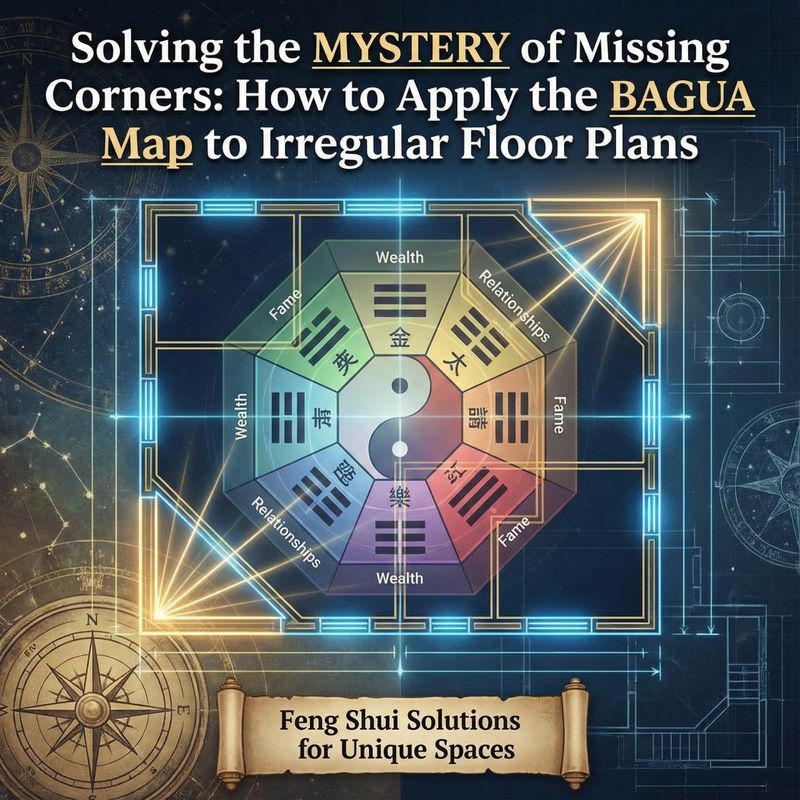
Beyond the Box: Navigating the Bagua in Non-Rectangular Homes
If you have been following our series on the Feng Shui Bagua map, you know exactly what the nine areas of life are (Post #1) and how to align the grid with your front door (Post #2). But let’s face it: modern architecture rarely adheres to the perfect square or rectangular shape that ancient Feng Shui masters preferred.
Perhaps you live in an L-shaped apartment, a U-shaped house, or a home with quirky architectural cutouts. When you try to overlay the 3x3 Bagua grid, you might panic realizing that an entire section of the map—perhaps your "Wealth" or "Relationship" area—seems to fall completely outside your walls.
This is known as a Missing Corner.
In this advanced guide, we will move beyond the basics to troubleshoot irregular floor plans. We will identify what missing corners mean for your energy and, most importantly, how to "cure" them without remodeling your home.
Missing Corner vs. Projection: Knowing the Difference
Before you rush to fix a problem, you must ensure you actually have one. In Feng Shui, irregular shapes result in either a Missing Corner (a deficit) or a Projection/Extension (a bonus).
Imagine drawing a box around the entire footprint of your home to complete the square.
- Missing Corner: If the "missing" part of the shape (the empty space inside your drawn box) is less than 50% of that side's total length, it is considered a missing corner. This represents missing Chi (energy) in that specific life area.
- Projection (Extension): If the part of the house that sticks out is less than 50% of the width of the house, that protruding area is considered an extension. Extensions are generally good luck! They provide extra energy to that specific Bagua area.
Note: If the shape is exactly 50/50, it is usually treated as a missing corner to be safe.
The Impact of Missing Corners
When a specific Gua (area) is missing from your floor plan, it can manifest as a recurring struggle in that area of your life. It doesn't mean you are doomed to failure, but it suggests you may have to work harder to maintain balance there because the architectural support isn't naturally present.
Here is a quick refresher on what could be affected based on the missing direction/area:
- Southeast (Wealth): Financial instability or difficulty accumulating savings.
- South (Fame): Lack of recognition, low self-esteem, or feeling invisible.
- Southwest (Relationships): Struggles in finding a partner, marital disharmony, or lack of maternal energy.
- East (Family): Family friction or health issues.
- Center (Health): Overall instability or lack of grounding.
- West (Children/Creativity): Creative blocks or difficulties with children.
- Northeast (Knowledge): Difficulty learning new skills or lack of spiritual growth.
- North (Career): Stagnation in professional life or lack of direction.
- Northwest (Helpful People): Feeling unsupported, struggling to find mentors, or lack of travel.
Top Feng Shui Cures for Missing Corners
If you have identified a missing corner, take a deep breath. In Feng Shui, intention is everything. There are "transcendental cures" used to symbolically complete the shape of your home and restore energetic balance. Here are the most effective methods.
1. The Mirror Correction (Internal Cure)
This is the most common indoor cure. Locate the wall that borders the missing area.
- The Fix: Place a large mirror on that wall.
- The Logic: Mirrors create depth. When you look into the mirror, the room appears to continue into the "missing" space. Symbolically, this pulls the missing energy back into the home.
- Tip: Ensure the mirror is clean and does not cut off the head of the tallest person in the home.
2. Lighting the Way (External Cure)
If you have access to the outside area where the corner is missing (e.g., a backyard or garden), you can complete the shape physically.
- The Fix: Install a lamp post, a heavy landscape rock, or a tall tree at the exact point where the corner would be if the house were a perfect square.
- The Logic: This anchors the energy outside, energetically completing the footprint of the home.
3. Use of Elementals
Enhance the wall closest to the missing sector with the element associated with that Bagua area. This strengthens the boundary and compensates for the lack of space.
- Missing Wealth (Southeast/Wood): Place lush, tall green plants along the wall or hang art depicting forests.
- Missing Career (North/Water): Use a water feature or black/blue imagery on the boundary wall.
- Missing Reputation (South/Fire): Use triangular shapes, bright lights, or red accents.
4. Faceted Crystal Balls
Feng Shui crystal balls (leaded glass faceted spheres) are powerful tools for manipulating Chi.
- The Fix: Hang a faceted crystal ball from the ceiling near the corner or window that borders the missing section.
- The Logic: The facets disperse energy in all directions, helping to circulate Chi that might otherwise stagnate or leak out of the irregular shape.
A Practical Example: The Missing "Wealth" Corner
Let’s say your home is L-shaped, and the missing section falls in the Southeast (Wealth & Prosperity) sector.
The Diagnosis: You might find that money flows out as fast as it comes in, or you feel anxious about finances regardless of how much you earn.
The Prescription:
- Identify the boundary wall: Find the interior walls that border the missing Southeast chunk.
- Apply the Mirror: Hang a mirror on this wall to energetically expand the room into the missing Wealth area.
- Boost the Element: Since Wealth is Wood, place a healthy, upward-growing plant (like a Money Tree or Bamboo) in front of that mirror. The reflection doubles the plant, symbolically doubling your growth.
- Set the Intention: As you place these items, visualize the structure of your home becoming whole and your financial life stabilizing.
Final Thoughts: Imperfection is Opportunity
It is rare to find a home with "perfect" Feng Shui. In fact, many practitioners believe that we attract the homes we need to learn specific lessons. A missing Relationship corner might be the universe's way of prompting you to put conscious effort into your partnerships rather than taking them for granted.
By applying the Bagua map to your irregular floor plan and using these cures, you aren't just decorating; you are actively engaging with your environment to create a life of balance, flow, and harmony.
Stay tuned for Post #4, where we will discuss the "Small Tai Chi"—how to apply the Bagua map to individual rooms for micro-adjustments!