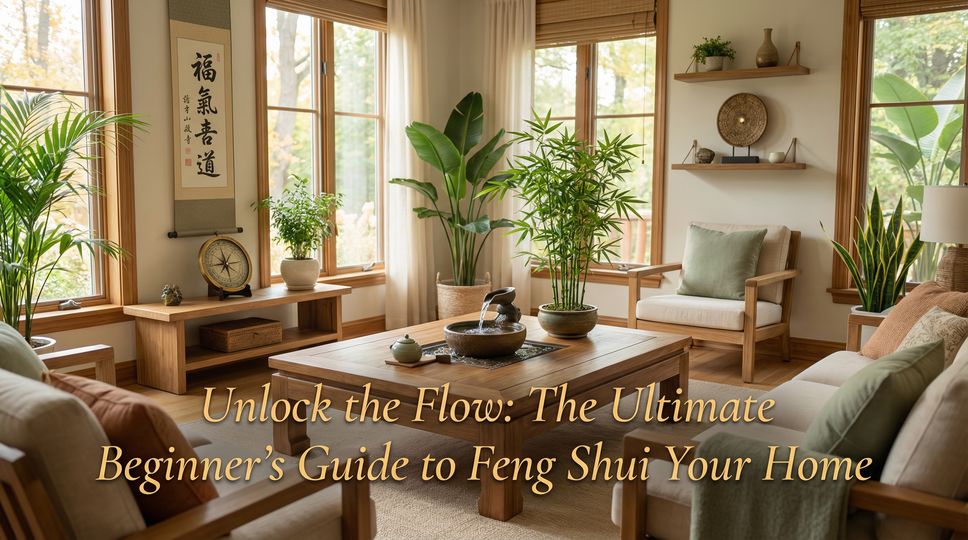
Unlock the Flow: The Ultimate Beginner’s Guide to Feng Shui Your Home
Have you ever walked into a room and immediately felt your shoulders drop and your breath deepen? Conversely, have you ever entered a space that made you feel anxious, tired, or inexplicably agitated?
This isn't just in your head—it is the energy of the space interacting with you. In the ancient Chinese practice of Feng Shui, this energy is known as Chi (or Qi).
Welcome to the first post in our comprehensive series on mastering your environment. Today, we are stripping away the superstition and complexity to look at the foundational principles of Feng Shui. Whether you live in a sprawling estate or a cozy studio apartment, applying these principles can harmonize your environment, improve your well-being, and invite prosperity into your life.
What Exactly is Feng Shui?
Literally translated, Feng means "wind" and Shui means "water." In Chinese culture, wind and water are associated with good health, thus good Feng Shui signifies good fortune.
At its core, Feng Shui is the art of placement. It is a system of laws that govern spatial arrangement and orientation in relation to the flow of energy. The goal is simple: to create an environment where energy flows freely and harmoniously, supporting the people who inhabit the space.
If you are ready to transform your home from chaotic to calming, here are the five essential pillars to get you started.
1. The "Mouth of Chi": Optimizing Your Entryway
In Feng Shui, your front door is considered the "Mouth of Chi." It is the primary portal through which energy enters your home and your life. If this area is blocked, dark, or unappealing, opportunity cannot find you.
How to Energize Your Entryway:
- Clear the Path: Ensure there are no obstacles behind the door (like coats, shoes, or boxes) that prevent it from opening a full 90 degrees. A door that doesn't open fully limits your potential.
- Light it Up: The entryway should be bright and welcoming. If you lack natural light, use warm, bright LED bulbs.
- Fix the Hardware: Does your door squeak? Is the lock sticky? A hard-to-open door symbolizes struggle. Oil the hinges and fix the handle to ensure smooth entry.
- Define the Space: Place a beautiful welcome mat to define the boundary between the outside world and your inner sanctuary.
2. The Art of Decluttering: Clearing Stagnant Energy
Clutter is the enemy of good Feng Shui. In energetic terms, clutter creates a traffic jam for Chi. It represents postponed decisions and the inability to move forward. You cannot invite new opportunities into your life if your space is filled with the old.
However, Feng Shui decluttering goes deeper than just tidying up. It is about addressing the emotional weight of objects.
Practical Decluttering Tips:
- The "Broken" Rule: Fix broken items immediately or discard them. Broken objects represent broken promises and drained vitality.
- Under the Bed: Your bed is where you recharge. Storing items under the bed (especially old letters, shoes, or exercise equipment) creates subconscious blockages that can affect your sleep and health. Ideally, leave the space under your bed empty.
- Top of Cabinets: Do not store heavy items high up on top of wardrobes or kitchen cabinets. This symbolizes problems hanging over your head and can induce subconscious anxiety.
3. The Command Position: Taking Control of Your Life
The "Command Position" is one of the most important and easiest principles to apply immediately. It governs how you position key furniture pieces—specifically your bed, your desk, and your stove.
To be in the command position, you must be able to see the door to the room without being directly in line with it.
Why It Matters:
- The Bed: When you sleep, you are vulnerable. Being in the command position allows your subconscious to relax because you can see anyone entering the room. If your feet point directly out the door (the "coffin position"), it is said to drain your life force.
- The Desk: Sitting with your back to the door while working can lead to feelings of insecurity and being "backstabbed" in business. Facing the entrance puts you in control of your career.
Quick Fix: If you cannot move your desk or bed to see the door, place a mirror so that you can see the reflection of the door from where you sit or lie.
4. The Five Elements: Creating Balance
Feng Shui divides the world into five elements: Wood, Fire, Earth, Metal, and Water. A balanced room contains all five elements in harmony. If a room feels "off," it is often because one element is dominating or missing.
The Elements Breakdown:
- Wood (Growth, Vitality): Represented by plants, the color green, and columnar shapes.
- Fire (Passion, High Energy): Represented by lighting, candles, the color red, and triangular shapes.
- Earth (Stability, Grounding): Represented by stones, ceramics, beige/earth tones, and square shapes.
- Metal (Focus, Clarity): Represented by metallic finishes, the colors white/grey, and round shapes.
- Water (Wisdom, Flow): Represented by mirrors, water features, the color black/dark blue, and wavy shapes.
Try This: Look at your living room. Do you have too much "Fire" (bright lights, red pillows)? Try balancing it with "Water" (a mirror or dark blue throw rug) to cool the energy down.
5. Yin and Yang: The Dance of Opposites
Just as nature has day and night, your home needs a balance of Yin (passive, soft, dark) and Yang (active, hard, bright) energy.
The function of the room dictates the balance:
- Yin Spaces (Bedrooms, Bathrooms): These should be relaxing. Use soft lighting, plush fabrics, and soothing colors.
- Yang Spaces (Kitchen, Home Office, Living Room): These are active spaces. Utilize brighter lights, vibrant colors, and more energetic artwork.
If you have trouble sleeping, your bedroom might be too Yang (too bright, too much clutter, or electronics present). If you feel lethargic in your office, it might be too Yin (too dark, not enough ventilation).
Conclusion: Start Small
Feng Shui is a journey, not a sprint. You do not need to rearrange your entire house in a single day. Start with one small area—perhaps your entryway or your bedside table.
As you make these adjustments, pay attention to how the energy shifts. Does the room feel lighter? Do you feel more focused? By consciously curating your environment, you are setting the stage for a life of balance, abundance, and flow.
Stay tuned for the next post in our series, where we will dive deep into the Bagua Map and how to locate the Wealth and Love corners of your home!