Demystifying the Bagua Map: The Blueprint to Your Home’s Energy
If you have ever felt like certain areas of your life are stuck—perhaps your career has plateaued, or your relationships feel stagnant—the answer might literally be hiding in your hallway. In Feng Shui, your home is not just a shelter; it is a living reflection of your inner life. The tool we use to decode this reflection is called the Bagua Map.
As the first post in our new Feng Shui series, we are going back to basics. The Bagua is arguably the most important tool in a consultant’s kit, yet it is often the most misunderstood. Today, we are going to walk you through exactly what it is, how to layer it over your floor plan, and how to use it to manifest change.
What is the Bagua Map?
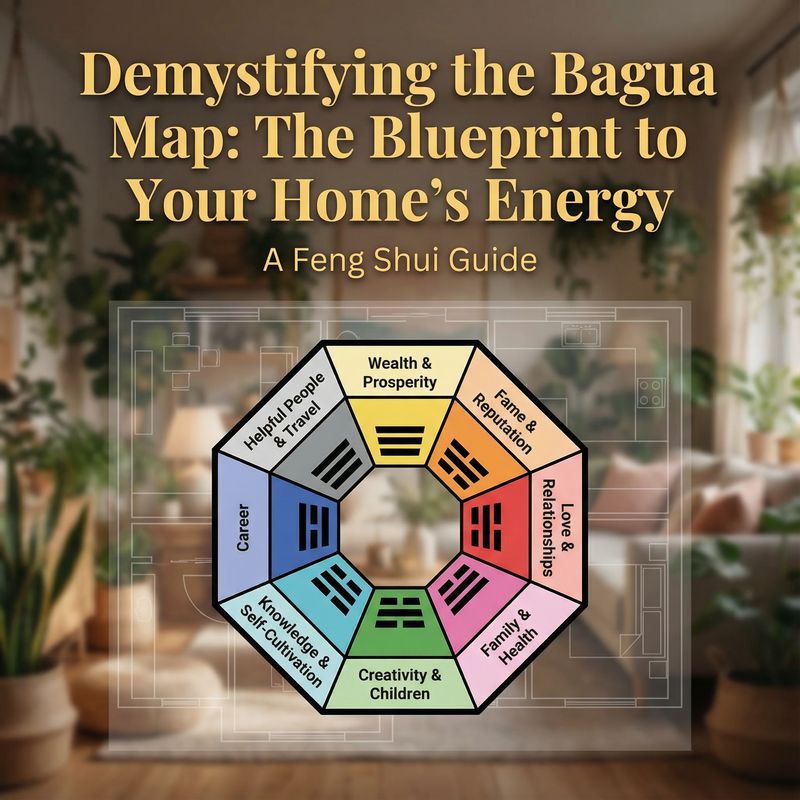
"Bagua" (pronounced bah-gwah) translates literally to "eight areas." It is an energy map consisting of eight areas around a center, totaling nine sectors. Each sector corresponds to a specific aspect of your life, a natural element, a color, and a shape.
Think of the Bagua as a grid that you lay over your home’s floor plan. Wherever a specific room falls within that grid, the energy of that room influences the corresponding life area.
The Two Schools of Thought
Before you begin, it is vital to choose your method. There are two primary ways to apply the Bagua:
- Classical (Compass School): This method relies on the magnetic directions (North, South, East, West). You need a compass to determine the facing direction of your home.
- BTB (Western School): This method aligns the map based on the front door of your home. It is generally considered more accessible for beginners and is highly effective for modern architecture.
For the purpose of this guide, we will focus on the BTB/Western method, as it focuses on how energy (Qi) enters your home through the "mouth of chi" (the main door).
The 9 Areas of the Bagua
Imagine a tic-tac-toe board or a 3x3 grid. Here is a breakdown of each square, starting from the bottom row (where your front door is) and moving up.
The Bottom Row (The Entry)
This row aligns with the wall containing your front door.
1. Knowledge & Self-Cultivation (Gen)
- Location: Bottom Left
- Element: Earth
- Color: Dark Blue, Black, Teal
- Focus: Personal growth, study, spirituality, and inner peace.
- Tip: A great place for a bookshelf, meditation corner, or reading nook.
2. Career & Life Path (Kan)
- Location: Bottom Center (often where the door is)
- Element: Water
- Color: Black, Very Dark Blue
- Focus: Your job, your purpose, and how you move through life.
- Tip: Ensure your entrance is well-lit and free of clutter to let opportunities flow in. Mirrors and water features work well here.
3. Helpful People & Travel (Qian)
- Location: Bottom Right
- Element: Metal
- Color: Gray, White, Metallics
- Focus: Getting support from others, networking, and travel luck.
- Tip: This is the spiritual corner of the home. Place metal objects or globes here to activate travel energy.
The Middle Row
4. Family & New Beginnings (Zhen)
- Location: Middle Left
- Element: Wood
- Color: Green, Teal
- Focus: Family harmony, paying bills, and starting new projects.
- Tip: Add healthy, tall green plants here to simulate growth and stability.
5. The Center (Tai Qi)
- Location: Dead Center
- Element: Earth
- Color: Yellow, Earth Tones, Orange
- Focus: General health, wellbeing, and unity.
- Tip: Keep this area open and clear. The center grounds the energy of the whole house. A square rug in earth tones is excellent here.
6. Children & Creativity (Dui)
- Location: Middle Right
- Element: Metal
- Color: White, Pastels, Metallics
- Focus: Joy, children, creative projects, and completion.
- Tip: Artwork, whiteboards for brainstorming, or round metal shapes enhance this area.
The Top Row
7. Wealth & Prosperity (Xun)
- Location: Top Left
- Element: Soft Wood
- Color: Purple, Gold, Red, Green
- Focus: Abundance, financial flow, and self-worth.
- Tip: Often called the "money corner." Place a healthy jade plant or a bowl of crystals (like citrine) here.
8. Fame & Reputation (Li)
- Location: Top Center
- Element: Fire
- Color: Red, Bright Orange
- Focus: How the world sees you, recognition, and passion.
- Tip: Good lighting is essential here. Use triangle shapes or the color red to ignite recognition.
9. Love & Relationships (Kun)
- Location: Top Right
- Element: Earth
- Color: Pink, Red, White
- Focus: Romantic partnerships, self-love, and platonic connection.
- Tip: Think in pairs. Two candles, two pillows, or artwork depicting couples.
How to Map Your Home: A Step-by-Step Guide
Now that you know what the areas represent, it is time to map your own space.
- Draw a Floor Plan: It doesn't need to be architecturally perfect, but try to get the relative scale of the rooms correct. Include the front door, back door, and windows.
- Orient the Map: Stand at your front door looking into your house.
- Divide into Nine: Draw a 3x3 grid over your floor plan. The bottom of the grid (Knowledge, Career, Helpful People) should align with the wall that contains your front door.
- Identify the Missing or Extended Areas: Most homes are not perfect squares.
- Missing Areas: If your home is L-shaped, a section of the Bagua might be missing outside the walls. This indicates a missing energy in your life (e.g., missing the Wealth corner).
- Extensions: Sometimes a room sticks out past the square; this is considered a bonus or "extension" of that energy.
Common Bagua Mistakes to Avoid
- Don't Bagua Everything at Once: It is tempting to try and "fix" every sector immediately. This scatters your energy. Pick 1-3 areas that are most critical to your current goals and focus there.
- The Garage Confusion: If you usually enter through the garage, you should still align the map based on the formal architectural front door, not the garage door. The front door is the "mouth of chi," regardless of which door you personally use.
- Ignoring Clutter: You can place all the wealth crystals you want in the top-left corner, but if that corner is filled with dusty piles of old magazines, the energy cannot flow. Clutter clearing always comes before curing.
Conclusion
The Bagua map is a profound tool because it helps us visualize the connection between our environment and our internal world. By making small, intentional changes in specific sectors of your home, you signal to the universe—and your subconscious—that you are ready for change.
Grab a piece of paper, sketch out your home, and discover what your floor plan has been trying to tell you. In our next post, we will dive deeper into "The Wealth Corner" and specific cures to boost your finances.
Happy mapping!