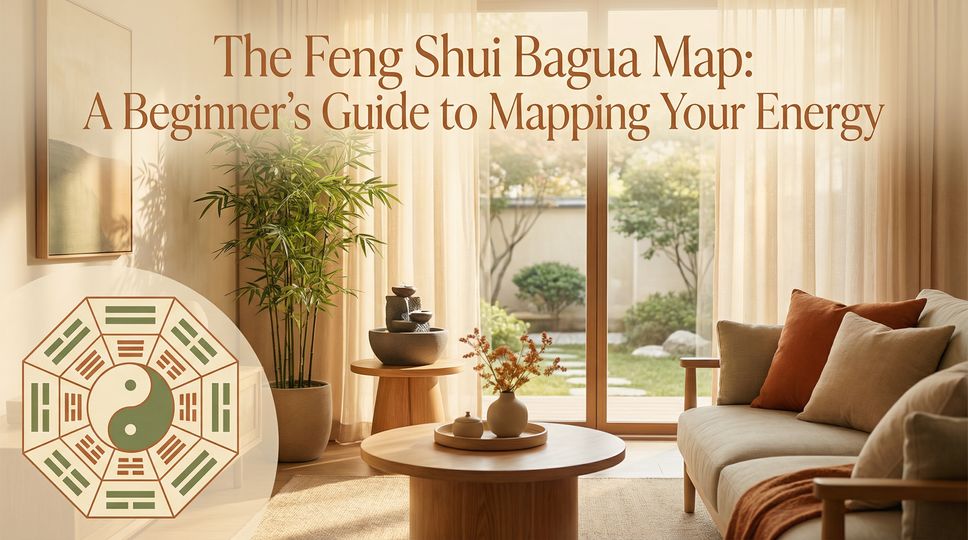
If you have ever felt that certain aspects of your life—be it your career, your relationships, or your finances—were stagnant, the solution might literally be right under your feet. In Feng Shui, your home is not just a shelter; it is a reflection of your life. The tool used to decode this reflection is called the Feng Shui Bagua Map.
As the first installment in our deep-dive series on Feng Shui fundamentals, we are going to demystify the Bagua. By the end of this guide, you will understand how to overlay this energy blueprint onto your home and identify which areas of your living space correspond to specific areas of your life.
What is the Bagua?
The word "Bagua" (pa-kua) literally translates to "eight areas" in Chinese. It is an energy map consisting of eight guas (areas) arranged around a center point, totaling nine sectors.
Think of the Bagua as a grid that you lay over your floor plan. It divides your space into nine separate zones, each corresponding to a different aspect of your life, as well as a specific element, color, and shape. When the energy (Chi) in a specific sector of your home is blocked or cluttered, you may experience difficulties in that corresponding area of your life.
The Two Schools of Thought
Before we dive into the map, it is crucial to know how to apply it. There are two primary ways to lay the Bagua map, depending on the school of Feng Shui you follow:
- Traditional (Compass) School: Uses the cardinal directions (North, South, East, West) determined by a compass reading to orient the map.
- Western (BTB) School: Aligns the map based on the architectural front door of the home.
For the purpose of this beginner's guide, we will focus on the Western School method, as it is the most accessible for modern homes and apartments.
The 9 Areas of the Bagua Map
To visualize this, imagine a Tic-Tac-Toe board or a 3x3 grid. Here is a breakdown of each square in that grid, moving from the top left to the bottom right.
1. Wealth & Prosperity (Xun)
- Location: Top Left (Back Left corner of the home)
- Element: Soft Wood
- Colors: Purple, Gold, Green
- Represents: Abundance, financial flow, and sense of worth.
- Feng Shui Tip: Place a healthy green plant or a small fountain here to stimulate growth and flow.
2. Fame & Reputation (Li)
- Location: Top Center (Back Middle)
- Element: Fire
- Colors: Red, Orange, Bright Yellow
- Represents: How the world sees you, visibility, and recognition.
- Feng Shui Tip: Add lighting, candles, or triangular shapes to ignite your passion and visibility.
3. Love & Marriage (Kun)
- Location: Top Right (Back Right corner)
- Element: Earth
- Colors: Pink, Red, White
- Represents: Romantic relationships, partnerships, and self-love.
- Feng Shui Tip: Use pairs of objects (two candles, two crystals) to symbolize union and partnership.
4. Family & New Beginnings (Zhen)
- Location: Middle Left
- Element: Hard Wood
- Colors: Green, Teal
- Represents: Family heritage, ancestors, and starting new projects.
- Feng Shui Tip: Display family photos or heirlooms here to honor your roots.
5. Health & Center (Tai Qi)
- Location: Center
- Element: Earth
- Colors: Yellow, Brown, Earth Tones
- Represents: Overall well-being, balance, and stability.
- Feng Shui Tip: Keep this area as open and uncluttered as possible to allow Chi to circulate throughout the rest of the house.
6. Children & Creativity (Dui)
- Location: Middle Right
- Element: Metal
- Colors: White, Metallics, Pastels
- Represents: Joy, creative expression, and children (or projects closest to your heart).
- Feng Shui Tip: This is a great place for art supplies, vision boards, or playful decor.
7. Knowledge & Self-Cultivation (Gen)
- Location: Bottom Left (Front Left corner)
- Element: Earth
- Colors: Dark Blue, Black, Dark Brown
- Represents: Personal growth, study, spirituality, and skill-building.
- Feng Shui Tip: Create a reading nook or meditation space here.
8. Career & Life Path (Kan)
- Location: Bottom Center (Front Middle)
- Element: Water
- Colors: Black, Very Dark Blue
- Represents: Your job, your deeper purpose, and how you move through life.
- Feng Shui Tip: Mirrors or water features work well here to symbolize fluidity and depth.
9. Helpful People & Travel (Qian)
- Location: Bottom Right (Front Right corner)
- Element: Metal
- Colors: Grey, White, Metallic
- Represents: Benefactors, mentors, clients, and international travel.
- Feng Shui Tip: Place a metal bell or images of places you wish to visit in this sector.
How to Apply the Bagua to Your Home
Ready to map your space? Follow these simple steps:
- Draw Your Floor Plan: Sketch the layout of your home. Include all rooms, the garage (if attached), and the front door.
- Draw a 3x3 Grid: On a piece of tracing paper or a digital overlay, draw a large square divided into nine equal sections.
- Align the Bottom Row: Align the bottom row of the grid (Knowledge, Career, Helpful People) with the wall containing your front door.
- If your door is in the center, it is in the Career area.
- If it is to the left, it opens into Knowledge.
- If it is to the right, it opens into Helpful People.
- Stretch to Fit: Stretch the grid so it covers the entire footprint of your home.
Common Bagua Challenges
Not all homes are perfect squares. Here are two common issues you might face:
Missing Areas
If you have an L-shaped home, a section of the Bagua might be "missing" outside the walls. This indicates a potential weakness in that area of life.
- The Fix: You can energetically complete the shape by placing a mirror on the interior wall facing the missing area, or by placing a light, flag pole, or heavy planter outside in the garden where the corner "should" be.
Extensions
Sometimes a room (like a sunroom) sticks out from the main square. This is considered a bonus! It means you have extra energy in that specific area of life.
Conclusion: Start Small
The Feng Shui Bagua map is a powerful diagnostic tool, but it can feel overwhelming to try and "fix" all nine areas at once. My advice? Pick one area where you currently feel the most resistance in your life.
Clean that sector, remove clutter, and add one intentional cure (like a plant or a specific color). Observe the shifts in your energy, and then move on to the next.
Stay tuned for the next post in this series, where we will dive deeper into the Five Elements and how to use them to cure energetic imbalances!