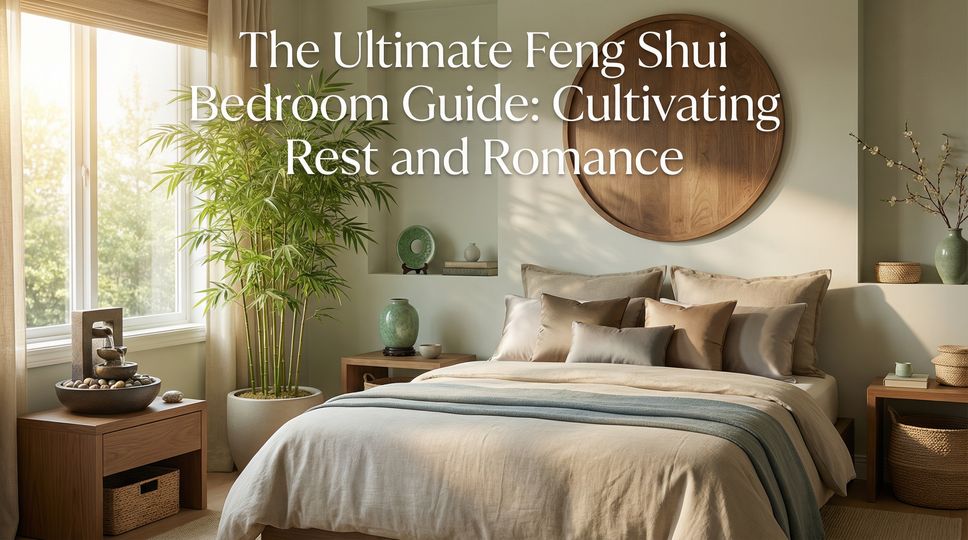
In the philosophy of Feng Shui, your home is a reflection of your inner life, and no room is more critical than the bedroom. We spend roughly one-third of our lives sleeping, making this space the primary location for recharging your personal energy, or Qi.
If you are feeling drained, restless, or experiencing stagnation in your romantic life, your bedroom's energy might be the culprit.
Welcome to the first post in our Feng Shui Living series. Today, we are diving deep into the Feng Shui Bedroom, moving beyond superstition to practical, energetic adjustments that transform your sleeping quarters into a sanctuary of restoration and intimacy.
The Core Philosophy: Yin Over Yang
To understand a Feng Shui bedroom, you must understand the balance of Yin and Yang.
- Yang energy is active, bright, loud, and moving (think: kitchen or living room).
- Yin energy is passive, soft, dark, and quiet.
A bedroom should be the most Yin space in your home. It is a place for pausing. Modern design often clutters bedrooms with exercise equipment, home offices, and televisions—all of which introduce aggressive Yang energy that disrupts sleep cycles. The first step in your journey is to ruthlessly eliminate these active elements.
1. The Command Position: Anchoring Your Safety
The most important principle in bedroom Feng Shui is the Command Position (or Power Position). This concept taps into our primal survival instincts. At a subconscious level, if you cannot see the entrance to the room, your nervous system remains on low-level alert, preventing deep relaxation.
How to Establish the Command Position:
- The View: Place your bed so that you can see the door while lying in it.
- The Alignment: Do not place the bed directly in line with the door (the "coffin position"). You want to be diagonal to the door, not straight on.
- The Fix: If your room layout forces you to have the bed on the same wall as the door, or directly in line with it, place a mirror strategically so you can see the reflection of the door from your bed without moving. This corrects the energetic vulnerability.
2. The Bed: Your Throne of Rejuvenation
Your bed is the most important piece of furniture in your life. It supports your energy for 8 hours a day. Here is how to optimize it:
The Headboard
A solid headboard represents stability in life and relationships.
- Best: Solid wood or upholstered fabric. This provides energetic support and protection for your head.
- Avoid: Metal bars (resembling a cage), slats, or having no headboard at all. Placing a bed directly against a window is also discouraged, as your Qi dissipates out the window during sleep, leading to fatigue.
Under the Bed
In Feng Shui, the space under your bed allows Qi to circulate freely to heal and regenerate you while you sleep.
- The Rule: Keep the space under the bed empty.
- The Exception: If you live in a small apartment and must use this storage, stick to soft, sleep-related items like spare linens or pillows.
- Never Store: Shoes (walking away energy), old love letters, photos of exes, or sharp objects. Sleeping on top of "emotional baggage" or active items creates subconscious blocks.
3. Colors: Skin Tones and Earth Elements
Because the bedroom is a Yin space, you want to avoid stimulating colors like bright reds, neons, or stark contrasting blacks and whites.
The Best Feng Shui Bedroom Colors:
- Skin Tones: From pale porcelain to rich chocolate browns. These are naturally soothing to humans.
- Earth Tones: Terracotta, sand, beige, and soft creams promote stability.
- Soft Blues/Greens: These represent healing and vitality, but keep them muted (pastels or sage) rather than electric.
Tip: If you want to introduce passion (Red/Fire element), do so sparingly with accents like a throw pillow or a candle, rather than painting an entire wall red, which can induce anxiety.
4. Symmetry: Inviting Partnership
Whether you are single and looking for love, or currently in a relationship, the bedroom should be designed for two people. Designing for one reinforces solitude.
Create balance by having:
- Two Nightstands: They do not have to match perfectly, but they should be of similar size.
- Two Lamps: One on each side to illuminate the space evenly.
- Space on Both Sides: Ensure there is walking room on both sides of the bed. Pushing a bed against a wall symbolizes one person being "trapped" in the relationship or having no room for a partner to enter your life.
5. Mirrors: The Energy Amplifiers
Mirrors are water energy; they reflect and amplify. In a bedroom, a large mirror can bounce energy around the room, making the space too active (Yang) for sleep. Many clients report insomnia that disappears once they cover their mirrors.
- Guideline: Try not to hang a mirror where you can see yourself while lying in bed.
- Solution: If you have mirrored closet doors, you can drape a curtain over them at night or apply a frosted film to diffuse the reflection.
6. Detox Your Environment
To truly create a sanctuary, you must address the invisible energy of modern life: EMFs (Electromagnetic Fields).
- Remove the TV: A television acts as a black hole for energy when off, and a source of chaotic noise when on. It kills intimacy.
- Phone Distance: Charge your phone in another room, or at least 5 feet away from your head.
- Books: While reading is good, huge stacks of books represent active heavy thoughts. Keep only the book you are currently reading on your nightstand.
Summary: Start Small
Feng Shui is not about perfection; it is about intention. You do not need to renovate your house today. Start with these three steps this weekend:
- Clear the clutter from under your bed.
- Ensure your bed is in the Command Position.
- Remove electronics and work materials.
By honoring your bedroom as a sacred space for rest, you signal to the universe that you value your own well-being. When your energy is restored, every other aspect of your life—career, family, and creativity—flourishes as a result.
Stay tuned for the next post in our series, where we will tackle the Feng Shui of the Entryway and how to invite opportunities into your home.