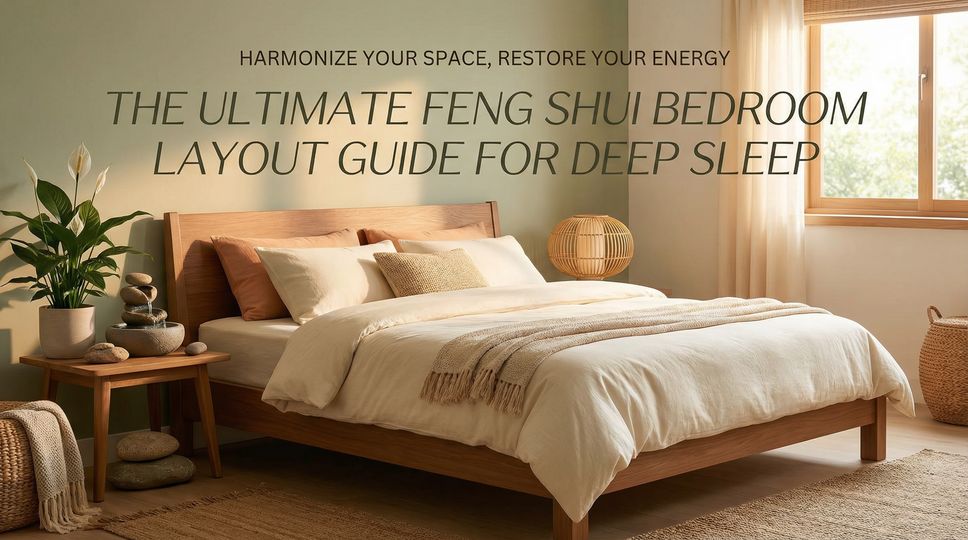
In the practice of Feng Shui, the bedroom is arguably the most critical room in your home. While the kitchen represents health and wealth, and the entry represents opportunities, the bedroom represents you—your personal energy, your relationships, and your ability to recharge.
We spend roughly one-third of our lives sleeping. During this state of passive vulnerability, we absorb the energy (Qi) of our surroundings more intensely than at any other time. If your bedroom energy is chaotic, stagnant, or aggressive, your sleep suffers, and by extension, your health and relationships suffer.
In this first installment of our Feng Shui series, we are going back to basics. Before we talk about colors or crystals, we must master the layout. Here is how to arrange your furniture to create a sanctuary of deep, restorative sleep.
The Concept of Yin and Yang in the Bedroom
To understand a Feng Shui bedroom, you must understand the balance of Yin and Yang. Living rooms and offices are Yang spaces—active, bright, and stimulating. Bedrooms should be primarily Yin—quiet, dark, passive, and nurturing.
Many modern design trends inadvertently introduce too much Yang energy into the bedroom (think massive TVs, exercise equipment, or home offices). The goal of your layout is to reduce stimulation and increase security.
1. The Golden Rule: The Command Position
If you take only one thing away from this guide, let it be the Command Position. This is the governing principle of furniture placement in Feng Shui.
Ideally, your bed should be placed so that you can see the door while lying in bed, but you should not be directly in line with it.
Why does this matter?
From an evolutionary psychology standpoint (which Feng Shui often mirrors), humans feel unsafe when their backs are to an entrance or when they cannot see who is approaching. Being in the command position lowers your primal alert levels, allowing your nervous system to switch into a deeper state of rest.
How to achieve it:
- Diagonal Placement: Place your bed on the wall diagonal to the door.
- The Fix: If your room layout forces you to have your back to the door (or the door is on the same wall as the headboard), place a mirror on the opposite wall or on a nightstand so you can see the reflection of the door from your pillow.
2. Avoid the "Coffin Position"
While you want to see the door, you strictly want to avoid having your feet point directly out the door. In traditional Chinese culture, this is known as the "Coffin Position" because the deceased are carried out of the room feet first.
Practically speaking, the doorway is a wind tunnel for Qi. Energy rushes in through the door. If you are lying directly in its path, that rushing energy can disturb your sleep, leading to restlessness or waking up tired.
The Fix: If you cannot move your bed, place a bench, a trunk, or a tall footboard at the end of the bed to act as a buffer for the incoming energy.
3. The Headboard: Your Mountain of Support
A solid headboard is non-negotiable in a Feng Shui bedroom. In Form School Feng Shui, we look for the "Black Turtle"—support behind us. Just as you wouldn't want to sit in a chair with a wobbly back, you shouldn't sleep without head support.
- Best Materials: Solid wood or upholstered fabric. These provide stability and softness.
- What to Avoid: Metal bars (which resemble prison bars and allow energy to slip through) or having no headboard at all.
- Placement: The headboard should be fastened securely and placed against a solid wall. Avoid placing your headboard against a window. Sleeping under a window weakens your personal Qi because you lack protection from the active energy outside, leading to fitful sleep.
4. Bed Framing and Space
For a balanced flow of energy (especially important for couples or those seeking a relationship), the bed needs to be approachable from both sides.
- Avoid pushing the bed against a corner. While this saves space, it creates an imbalance. The person sleeping against the wall may feel "trapped" or metaphorically suffocated in the relationship.
- Symmetry is key. Aim for two nightstands and two lamps, even if they don't match perfectly. This invites partnership and balance.
5. Beams and Ceiling Fans
Look up. What is directly above your bed?
Heavy architectural beams or massive ceiling fans directly over the bed can create subconscious oppression. In Feng Shui, this is called "cutting Qi." It exerts a downward pressure that can manifest as headaches, body aches, or just a feeling of heaviness upon waking.
The Fix:
- If you have beams, consider draping fabric over them to soften the edge.
- If you are renting and cannot move the bed or the fan, try to position the bed so the heavy object is over your legs rather than your head or torso.
6. Mirrors: The Energy Amplifiers
This is a controversial topic, but generally, Feng Shui experts advise against large mirrors in the bedroom, especially if they face the bed.
Mirrors reflect and bounce energy around a room. Remember, we want a Yin (quiet) environment. Mirrors are active Yang objects. If you are struggling with insomnia, cover your bedroom mirrors for a few nights and see if your sleep quality improves.
7. What Lies Beneath
Finally, let’s talk about storage. In smaller homes, under-the-bed storage is common, but it can block the flow of Qi.
Energy needs to circulate around your mattress to heal and restore you. If you stuff old shoes, tax documents, or "clutter" under your bed, you are literally sleeping on top of your unresolved problems and stagnant energy.
The Rule: Ideally, keep the space under your bed empty. If you absolutely must use it for storage, use it only for soft, sleep-related items like spare pillows, blankets, or linens.
Summary Checklist for Your Bedroom Layout
- Move the bed to the command position (diagonal from the door).
- Ensure a solid wall is behind your headboard.
- Clear the clutter from under the bed.
- Create space on both sides of the bed.
- Check your line of sight—ensure you aren't staring at a mirror or a bathroom door.
By implementing these layout changes, you set the stage for a room that doesn't just look good, but feels safe. Once the energy flow is corrected, you create the fertile ground necessary for rest, romance, and rejuvenation.
Stay tuned for Part 2 of our series, where we will dive into the Feng Shui color psychology for the bedroom.