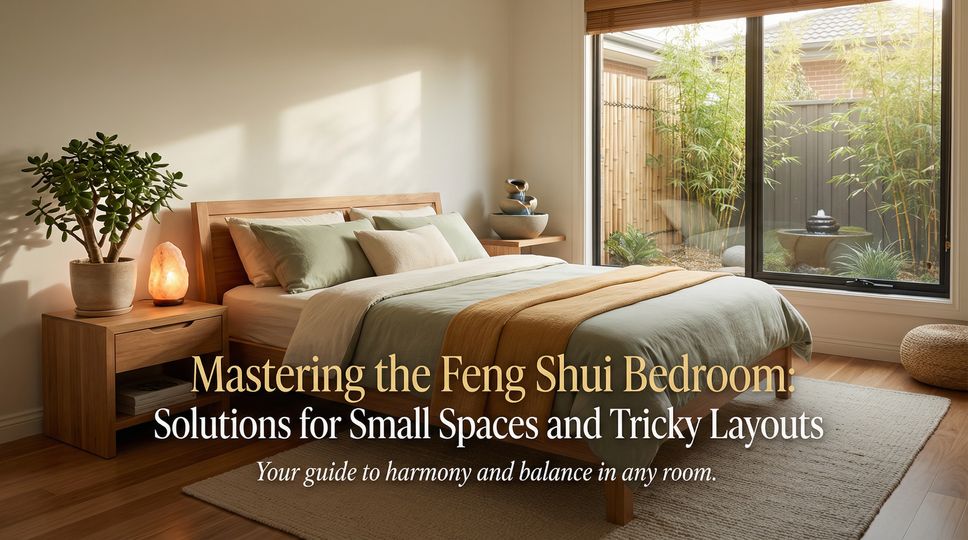
Can You Have Good Feng Shui in a Small Bedroom?
In the world of interior design and energy work, the "ideal" bedroom is often depicted as a spacious sanctuary with perfect symmetry, miles of walking room, and a bed floating effortlessly in the center. But reality often looks different. Whether you are living in a studio apartment, a historic home with quirky architecture, or simply a smaller modern bedroom, you might feel that the strict rules of Feng Shui are impossible to apply.
This brings us to the second installment of our Feng Shui Bedroom series. While our first post covered the foundational basics, today we are tackling the real-world challenges: Small spaces and tricky layouts.
The good news? Size doesn’t dictate energy quality. You can cultivate restorative, positive Chi (energy) in a bedroom of any size. In fact, smaller spaces can sometimes be easier to turn into cozy, yin-rich cocoons for sleep—if you know how to manage the flow.
Here is your guide to mastering the Feng Shui bedroom when space is limited.
1. The Bed Placement Challenge
In Feng Shui, the Command Position is paramount. Ideally, you want to see the door from your bed without being directly in line with it. In a small room, however, your options for bed placement are often severely restricted.
The Problem: The "Coffin Position"
If your room is narrow, you might be forced to place the bed so your feet point directly out the door. This is known as the "Coffin Position" and is said to drain your energy while you sleep.
The Cure:
If you cannot move the bed, block the direct line of energy.
- Footboard: Use a bed frame with a solid footboard.
- Bench or Ottoman: Place a piece of upholstered furniture at the foot of the bed.
- Rug: Place a small rug between the foot of the bed and the door to visually and energetically slow the Chi.
The Problem: The Bed Against the Wall
In a tiny room, pushing the bed into a corner (so one side is against a wall) is a common space-saver. However, this blocks energy flow to one partner (if shared) and symbolizes a lack of flexibility.
The Cure:
- Create "Virtual" Space: If you absolutely must have the side against a wall, place a mirror on the wall above the mattress line (not facing the sleeper directly, but alongside) to visually expand the space, or hang a picture of an open landscape to symbolize depth.
- Pull it Out Slightly: Even leaving 3 to 4 inches of space between the mattress and the wall allows for a small amount of Chi circulation.
The Problem: The Window Headboard
Ideally, you want a solid wall behind your head for support. In small rooms, sometimes the window wall is the only option.
The Cure:
- Heavy Drapes: Use thick, high-quality curtains and close them at night to create a "solid wall" sensation.
- Solid Headboard: A sturdy, tall headboard is non-negotiable here. It provides the energetic mountain of support you are missing from the wall.
2. Managing "Stuff" and Stagnant Chi
In a small Feng Shui bedroom, clutter is your biggest enemy. Clutter blocks the flow of Chi, causing stagnation which can lead to restless sleep and anxiety. In a tight space, clutter accumulates faster and feels heavier.
Under-Bed Storage Rules
Space is at a premium, so utilizing the area under the bed is tempting. Feng Shui generally advises against this because you want air to circulate under you while you sleep.
The Compromise:
If you must use under-bed storage, stick to soft items only. Store seasonal linens, extra blankets, or pillows.
- Avoid: Shoes (walking energy), luggage (travel energy), old memorabilia (emotional baggage), or sharp objects.
- Tip: Use soft storage bags rather than hard plastic bins if possible to keep the energy soft.
The Nightstand Dilemma
Symmetry promotes balance in relationships and energy. In a small room, you may not have room for two full-sized nightstands.
The Solution:
Aim for visual balance rather than identical furniture.
- If one side has a nightstand, the other side could have a small floating shelf.
- Ensure both sides have access to a lamp or lighting source.
- Keep the surfaces clear. A glass of water and a book are fine; a stack of bills and three coffee cups are not.
3. Mirrors: Expanding Space vs. Restless Energy
Interior designers love mirrors in small rooms because they double the visual space. However, in a Feng Shui bedroom, mirrors can be tricky. They activate energy (Yang) and can cause sleeplessness if they reflect the bed.
How to use them in a small room:
- Placement: Try to position mirrors so they do not face the bed directly. If you wake up and see your movement in a mirror, it triggers an alert response in the brain.
- Inside Closet Doors: This is the best place for a full-length mirror in a small bedroom.
- The Cover-Up: If you have mirrored closet doors that face the bed, consider applying a frosted film or using a curtain track to cover them while you sleep.
4. Vertical Energy and Lighting
When you don't have horizontal space, you must work with vertical space to lift the Chi.
- Tall Furniture: Use tall, slender dressers rather than wide ones to allow for more flow on the floor.
- Uplighting: Use sconces or floor lamps that direct light upward. This lifts the energy of the room, making a cramped space feel airier and less oppressive.
- Ceiling Fans: Be careful with ceiling fans in small rooms with low ceilings. Sleeping directly under a spinning fan can cause "cutting" energy. If you have one, try not to position the bed directly beneath the blades, or use a canopy/poster bed to create a protective layer.
5. Color Palettes for Small Spaces
While white is often used to make small rooms look bigger, a stark white room can feel cold and clinical (too much metal element). For a Feng Shui bedroom, you want Yin energy—cozy, dark, and restorative.
Don't be afraid of color in a small room. Soft earth tones (beiges, terracottas), soothing greens (wood element), or soft blues (water element) can make the walls recede while creating a womb-like atmosphere that promotes deep sleep.
Tip: Avoid high-contrast feature walls in very small bedrooms, as they can "chop" the visual space and make the room feel disjointed.
Final Thoughts: Intention Over Perfection
The most important tool in Feng Shui is your intention. If your bedroom is small or oddly shaped, do not stress over the rules you cannot follow. Stress generates negative Chi, which defeats the purpose entirely.
Focus on what you can control:
- Keep it clean and decluttered.
- Ensure the bed feels secure and comfortable.
- Remove electronics to reduce EMFs and mental noise.
By treating your small bedroom with care and respect, you turn it into a jewel box of restorative energy, proving that you don't need a mansion to have a masterfully aligned life.
Stay tuned for Part 3 of our series, where we will discuss Feng Shui for Romance and Partnership!