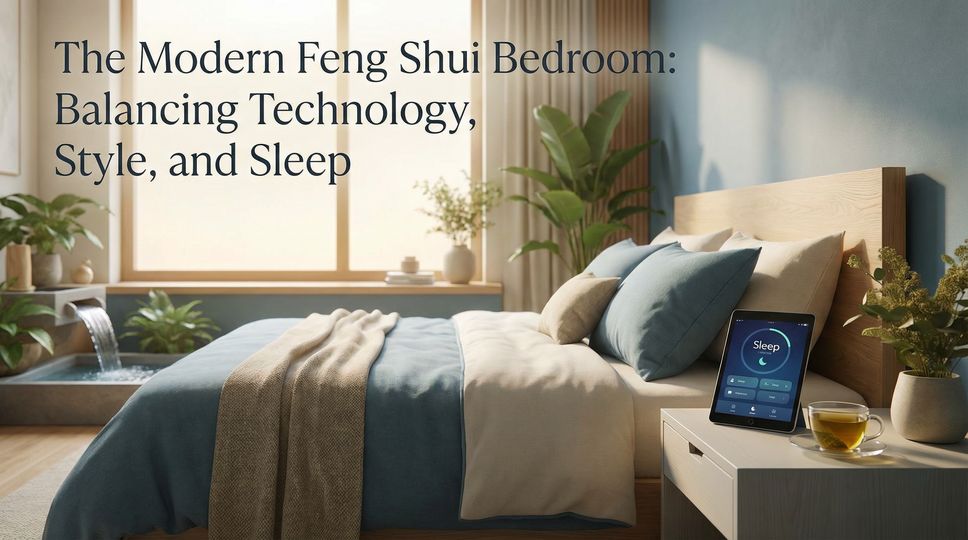
In previous posts, we’ve covered the basics of the Command Position, the importance of color psychology, and how to declutter for clarity. But let's be honest: we don't live in ancient China. We live in a world of smartphones, smart TVs, heavy work-from-home schedules, and often, cramped urban apartments.
This brings us to a crucial, often overlooked aspect of designing a sanctuary: How do we apply Feng Shui bedroom principles to a thoroughly modern lifestyle?
In this guide, we will explore how to bridge the gap between ancient wisdom and modern necessity, focusing on mitigating the impact of technology and harmonizing contemporary interior design trends with the flow of Qi (energy).
The Conflict: High-Tech vs. Restorative Yin Energy
The bedroom is intended to be a place of distinct Yin energy. Yin is slow, dark, passive, cooling, and quiet. It is the energy of restoration. Conversely, modern technology—smartphones, laptops, modems, and televisions—represents extreme Yang energy. They are active, stimulating, bright, and demanding of our attention.
When you fill a bedroom with active Yang devices, you disrupt the body's natural ability to wind down. Here is how to manage the "Electronic Smog" in your bedroom without going completely off the grid.
1. The Digital Detox Zone
Ideally, your bedroom should be a no-phone zone. However, if you rely on your phone for an alarm, you must create energetic boundaries.
- The 3-Foot Rule: Keep your phone at least three feet away from your head while sleeping. Ideally, charge it across the room. This reduces the immediate electromagnetic field (EMF) influence and prevents the urge to "doom scroll" first thing in the morning.
- Cover the Black Mirrors: In Feng Shui, television screens act as mirrors. They bounce energy around the room and, when off, look like black holes absorbing light. If you must have a TV in the bedroom, house it in a cabinet with doors, or drape a beautiful piece of fabric over it when not in use.
- Check Your Router: Never place a Wi-Fi router in the bedroom, and absolutely never under the bed. The frenetic energy of high-speed data transfer disrupts the passive energy needed for deep REM sleep.
Modern Minimalism vs. Feng Shui Warmth
A popular trend in modern interior design is strict minimalism—stark white walls, sharp lines, and metal accents. While visually clean, this can sometimes create an environment that feels "cold" or sterile in Feng Shui terms, lacking the nourishing energy required for emotional bonding and sleep.
Softening the Edges
If you love the modern aesthetic, you can maintain it while improving the Feng Shui:
- Balance the Elements: If your room features a lot of white and metal (Metal Element), it can promote rigidity and solitude. Introduce the Earth Element to ground the space. Use a beige upholstered headboard, a wool rug in warm taupe, or ceramic lamps.
- Round the Corners: "Poison Arrows" (Sha Qi) are sharp corners that point directly at the bed. Modern furniture often has sharp, square edges. Soften these by draping a throw blanket over the corner of a dresser or placing a round trailing plant to diffuse the cutting energy.
- Textural Variety: To prevent a minimalist room from feeling Yin-deficient (too cold), layer textures. Mix smooth cotton sheets with a chunky knit throw or velvet pillows. This invites tactile comfort, which signals safety to the subconscious mind.
The Storage Dilemma: Under the Bed
In modern apartments, storage space is premium real estate. Ancient Feng Shui dictates that nothing should be stored under the bed to allow Qi to circulate freely around your sleeping form.
However, if you have a platform bed with built-in drawers or a small studio where under-bed storage is non-negotiable, here is the modern compromise:
The "Soft Things Only" Rule
If you must utilize the space under your bed, follow these strict guidelines:
- No Active Items: Do not store shoes (walking energy), luggage (travel energy), or exercise gear (exertion energy) under the bed. These vibrate with activity and can cause restless sleep.
- No Sharp Objects: Avoid storing hard goods, boxes of memorabilia, or old papers/photos (which hold emotional past energy).
- Linens Only: The only "safe" items to store under the bed are soft linens, blankets, towels, or off-season clothing (specifically soft sweaters, not heavy coats or shoes). These items are neutral and do not project "noise."
Lighting: The Artificial Sun
Lighting is a powerful activator of Qi. In the old days, we relied on the sun and fire. Today, we have LEDs that can mimic high noon at midnight.
- Color Temperature Matters: Ensure your bedroom bulbs are "Warm White" (2700K - 3000K). Avoid "Daylight" or "Cool White" (5000K+) bulbs in the bedroom, as the blue light spectrum suppresses melatonin production.
- The Power of Dimmers: Install dimmer switches. As the evening progresses, manually lower the lights to simulate the setting sun. This is a physical cue to your body and your home's energy that the day is transitioning to night.
- Blackout Solutions: Light pollution from street lamps acts as intrusive Yang energy. heavy, lined curtains are excellent for Feng Shui as they provide a cocooning effect and block external visual noise.
The Home Office in the Bedroom
Perhaps the biggest modern Feng Shui challenge is the "cloffice" or the desk in the bedroom. Working where you sleep blurs the line between rest and stress.
If you cannot move the desk out:
- Visual Separation: Use a folding screen or a bookshelf to physically divide the sleeping area from the working area.
- The End-of-Day Ritual: At the end of the workday, completely clear the desk surface. Close the laptop and put it in a drawer. If you can see your work from your pillow, your mind will remain active.
- Positioning: Ensure you are not looking at the bed while working (makes you groggy) and not looking at the desk while in bed (makes you anxious).
Conclusion
Creating a Feng Shui bedroom in the modern age isn't about rejecting technology or style; it is about intentionality. It is about acknowledging that our environments have a profound impact on our internal state.
By creating boundaries with your electronics, softening modern design with tactile warmth, and being mindful of what lies beneath your bed, you can cultivate a space that supports deep rest—even in a fast-paced world.
Ready to dive deeper? In our next post, we will explore the relationship between mirrors and dreams, and why mirror placement is more controversial than you think.