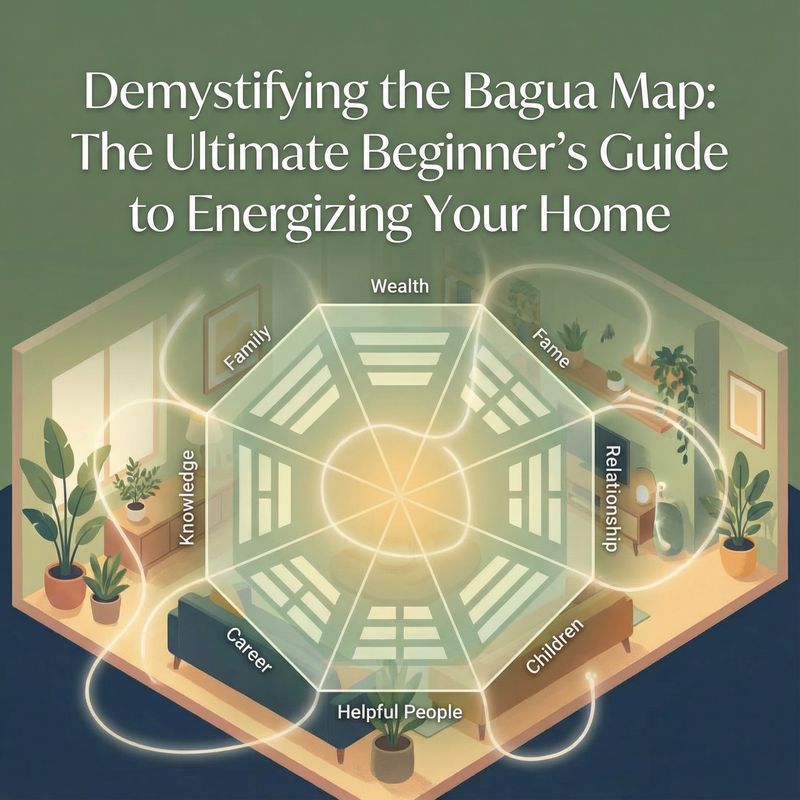
If Feng Shui were a journey, the Bagua map would be your GPS. Without it, you might be placing distinct cures in the wrong corners, effectively trying to water your garden with a lamp cord. It just won’t work.
Many beginners find the concept of the Bagua intimidatng. It looks like a complex octagonal grid filled with I-Ching triggers and foreign symbols. However, at its core, the Bagua is simply an energy blueprint. It connects specific areas of your physical space to specific aspects of your life, such as your career, your relationships, and your wealth.
In this guide, we are going to break down exactly what the Bagua map is, the significance of the nine life areas, and a step-by-step tutorial on how to overlay this map onto your own floor plan to start shifting the energy in your home immediately.
What is the Bagua Map?
"Bagua" (or Pa Kua) literally translates to "eight areas" in Chinese. The center creates the ninth area. In Feng Shui, we believe that your home is a living entity and a mirror of your internal life. The Bagua is the tool used to diagnose which parts of your home correspond to specific life circumstances.
There are two main ways to apply the Bagua:
- Classical (Compass) School: Uses the actual magnetic directions (North, South, East, West) to orient the map.
- Western (BTB) School: Aligns the map based on the front door of the home or room.
For the purpose of this beginner-friendly guide, we will focus on the Western/BTB method, as it is often the most accessible way to start practicing Feng Shui immediately without needing a precise compass reading.
The 9 Guas: Knowing Your Zones
Before you draw your map, you need to understand the terrain. The Bagua is divided into a 3x3 grid. Each square (or "Gua") has a corresponding element, color, and life aspiration.
1. Wealth & Prosperity (Xun)
- Location: Back Left
- Element: Wood
- Colors: Purple, Gold, Green
- Represents: Abundance, financial flow, and self-worth.
2. Fame & Reputation (Li)
- Location: Back Center
- Element: Fire
- Colors: Red, Orange
- Represents: Visibility, how the world sees you, and inspiration.
3. Love & Relationships (Kun)
- Location: Back Right
- Element: Earth
- Colors: Pink, Red, White
- Represents: Romantic partnership, self-love, and feminine energy.
4. Family & New Beginnings (Zhen)
- Location: Middle Left
- Element: Wood
- Colors: Green, Teal
- Represents: Ancestors, immediate family, and starting new projects.
5. Health & Center (Tai Qi)
- Location: Center
- Element: Earth
- Colors: Yellow, Earth Tones, Brown
- Represents: Physical health, stability, and overall balance. This anchors the other areas.
6. Children & Creativity (Dui)
- Location: Middle Right
- Element: Metal
- Colors: White, Metallics
- Represents: Joy, children, creative projects, and completion.
7. Knowledge & Self-Cultivation (Gen)
- Location: Front Left
- Element: Earth
- Colors: Dark Blue, Black
- Represents: Skills, study, spirituality, and personal growth.
8. Career & Life Path (Kan)
- Location: Front Center
- Element: Water
- Colors: Black, Very Dark Blue
- Represents: Your job, your calling in life, and the flow of your journey.
9. Helpful People & Travel (Qian)
- Location: Front Right
- Element: Metal
- Colors: Grey, White
- Represents: Mentors, synchronicity, travel, and masculine energy.
How to Overlay the Bagua Map on Your Home
Now that you understand the zones, it is time to map your space. Follow these three steps to create your energy blueprint.
Step 1: Sketch Your Floor Plan
You don't need to be an architect. Draw a rough outline of your home’s perimeter. Include the front door (the main architectural entry, even if you usually enter through the garage).
Step 2: Draw a Nine-Square Grid
Imagine placing a tic-tac-toe board over your floor plan. Stretch the grid so it covers the entire layout of your home.
Step 3: Align with the Front Door
The bottom row of the grid (Knowledge, Career, Helpful People) must align with the wall containing your front door.
- If your door is on the left side of the wall, you enter through the Knowledge area.
- If your door is in the center, you enter through the Career area.
- If your door is on the right, you enter through the Helpful People area.
Common Challenges: Missing Areas and Extensions
Modern architecture rarely provides us with a perfect square home. You may have an L-shaped house or a T-shaped apartment. This results in "missing corners" or "extensions."
- Missing Areas: If your home is L-shaped, one or more Guas might be outside the walls of your home. For example, if the back left corner is "missing," you may struggle with accumulating wealth.
- The Fix: You can energetically close the space by placing a mirror on the wall facing the missing area, or by placing a lamp post or heavy rock in the garden where the corner should be to anchor the energy.
- Extensions: Sometimes an area projects outward (like a sunroom). This is usually considered positive, as it means you have extra energy in that specific area of life.
3 Quick Tips to Activate Your Bagua Today
Once you have mapped your home, don't try to fix everything at once. Choose one to three areas to focus on.
- Fix the "Mouth of Chi": Since the Bagua aligns with the front door, ensure your Career area (the entry) is bright, decluttered, and the door opens fully without squeaking. This invites opportunity in.
- Check Your Wealth Corner: Go to the far back left corner of your home. Is it a bathroom? Is it cluttered? Clean it up and add a healthy green plant (Wood element) to symbolize growth.
- Stabilize the Center: The Health center touches all other areas. Keep the center of your home open and free of heavy furniture if possible, allowing energy to circulate to the peripheral Guas.
Final Thoughts
The Bagua map is a diagnostic tool, not a rigid rulebook. As you begin to layer this template over your living space, pay attention to your intuition. If your Relationship corner is filled with dying plants or clutter, don't panic—simply view it as a helpful signpost showing you exactly where to direct your love and attention.
Start with your floor plan today, and watch how shifting your home begins to shift your life.